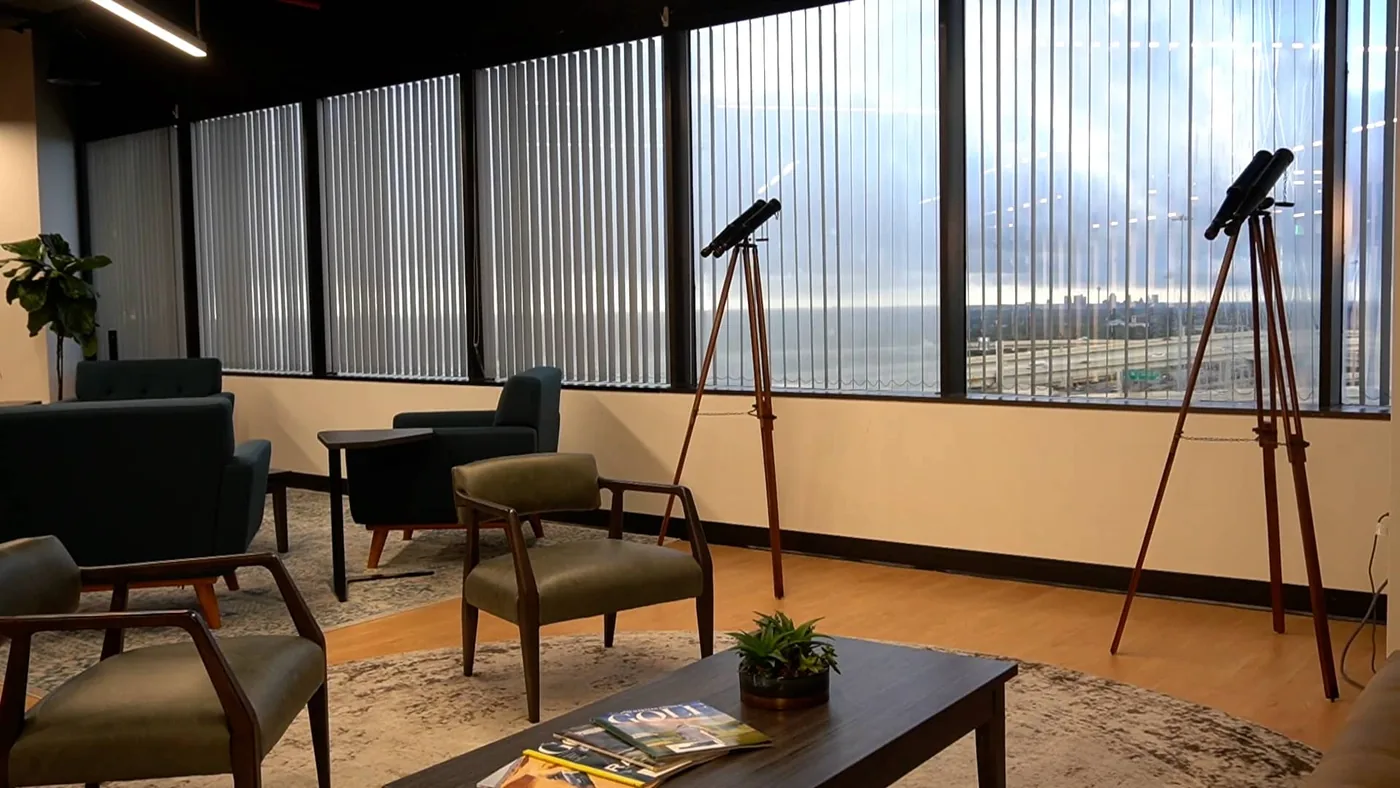
Coworking amenities remove the friction of a traditional office by bundling flexibility, infrastructure, and professional services into one adaptable model. Instead of a multi-year lease, a buildout, and fixed square footage, a business gets a fully equipped environment that scales with actual usage.
The short version:
- Coworking amenities replace many functions of an office lease without the commitment.
- Flexible models cut wasted space, upfront cost, and operational overhead.
- A professional presence is maintained through virtual offices, meeting access, and shared infrastructure.
- Coworking supports hybrid work by combining on-demand space with remote flexibility.
- Businesses can scale up or down without relocating or paying penalties.
The problem coworking amenities solve
Conference rooms, mail handling, a business address, shared technology, and staffed reception replace what would otherwise require ownership or a long commitment. The result is a workspace that adjusts to the business rather than the other way around.
For San Antonio professionals dealing with hybrid schedules, changing headcount, or uncertain growth timelines, coworking amenities work as a genuine alternative to leased office space — not a stopgap.
The real risks in an office lease
Office decisions carry consequences well beyond monthly rent. Commercial leases typically require multi-year terms, personal guarantees, and significant investment before the business can even operate from the space.
The common exposures:
- Paying for empty offices and desks through remote or hybrid periods
- Absorbing buildout and furnishing costs that cannot be recovered
- Facing renegotiation or penalties when space needs change
- Running utilities, cleaning, security, and IT yourself
Coworking shifts most of those fixed risks into shared, managed services — reducing financial exposure while keeping access to professional-grade space.
Amenities as a complete office system
Coworking amenities are often mistaken for conveniences. In practice they replace the core components of an office.
Rather than leasing empty square footage, a business gets:
- Furnished workspace ready for immediate use
- Shared conference rooms available on demand
- Centralized utilities, internet, and maintenance
- Mail handling, package reception, and a business address
- Front-desk support and secure building access
That gives a business the functional capability of a private office without the setup delay or the ongoing management. For teams that need physical space only part of the week, usage finally matches need.
What decision-makers actually evaluate
Flexibility without lease penalties
Businesses can change their footprint without renegotiating a lease or relocating. Dedicated desks, private offices, and shared access can be adjusted as circumstances change.
Cost predictability
A monthly membership consolidates what would otherwise be rent, utilities, internet, cleaning, and maintenance into one figure — simplifying budgeting and removing surprise costs.
Professional presence without full-time occupancy
Many businesses need a credible address, meeting space, and a client-facing environment without using an office daily. Virtual office services and on-demand meeting rooms cover exactly that.
Support for hybrid teams
Coworking accommodates people splitting time between home and office. Teams collaborate in person when it helps, without maintaining permanently under-used space.
Infrastructure that scales
As teams grow or contract, members expand into private offices or scale back to shared access without disrupting operations or changing address.
Traditional office versus coworking amenities
Lease commitment — multi-year contracts, versus monthly or flexible terms.
Upfront costs — buildout, furniture, and deposits, versus minimal or included.
Scalability — requires renegotiation or relocation, versus adjusting space as needed.
Utilities and maintenance — managed by the tenant, versus included and managed for you.
Meeting rooms — dedicated and often under-used, versus shared and reservable.
Professional address — included in both.
Hybrid work support — limited, versus built in.
Four assumptions worth revisiting
"Coworking is only for freelancers"
Freelancers are common members, but coworking also supports startups, established companies, and distributed teams that want a satellite office or a flexible footprint.
"Shared spaces lack professionalism"
Modern coworking is designed around business credibility: private meeting rooms, controlled access, and professional reception. Clients generally cannot tell the difference, except that the parking is easier.
"Amenities are optional extras"
In a coworking model amenities replace traditional office systems rather than supplementing them. They are how the workspace functions.
"Coworking is temporary"
Many businesses use it as a long-term solution, scaling within the same building as needs change instead of relocating every few years.
How businesses grow through the stages
Many San Antonio businesses follow the same phased path:
- Virtual office — establish a professional address and mail handling while operating remotely.
- Shared coworking access — add open workspace and meeting rooms as collaboration increases.
- Dedicated desk or private office — expand into defined space without leaving the environment.
- Long-term hybrid use — keep flexibility while supporting growth or a distributed team.
Each step is reversible, which is the part a lease can never offer.
Evaluating it as a next step
Focus on alignment rather than urgency:
- Work out how often you genuinely need physical space
- Compare your current office costs against a shared-service model
- Assess your meeting and collaboration requirements honestly
- Tour spaces to understand layout, access, and amenities in person
- Check how the virtual and physical services integrate
The goal is not to replace every office function at once. It is to remove friction where a lease creates constraints you do not need.
Related reading
See the space
SA Cowork is at 7550 I-10, Suite 1400, San Antonio, TX 78229 — off the I-10 and 410 interchange, with free covered parking, 24/7 member access, and meeting rooms available on demand.
Book a tour or call (210) 985-9749.